























CBN: The sleep cannabinoid - effects, studies & dosage
The most important thing: CBN is produced by THC oxidation – not by extraction. CBN alone has no measurable sleep effect. Only CBN+THC combined is measurably more sedating than THC alone…

Contents
- CBN alone = no measurable sleep effect – only CBN+THC combined significantly more sedative
- CBN is the first cannabinoid ever isolated (1899) – was long known as an inactive degradation product
- Old cannabis contains more CBN due to THC oxidation – this explains the sedative effect of old samples
What is CBN (cannabinol)?
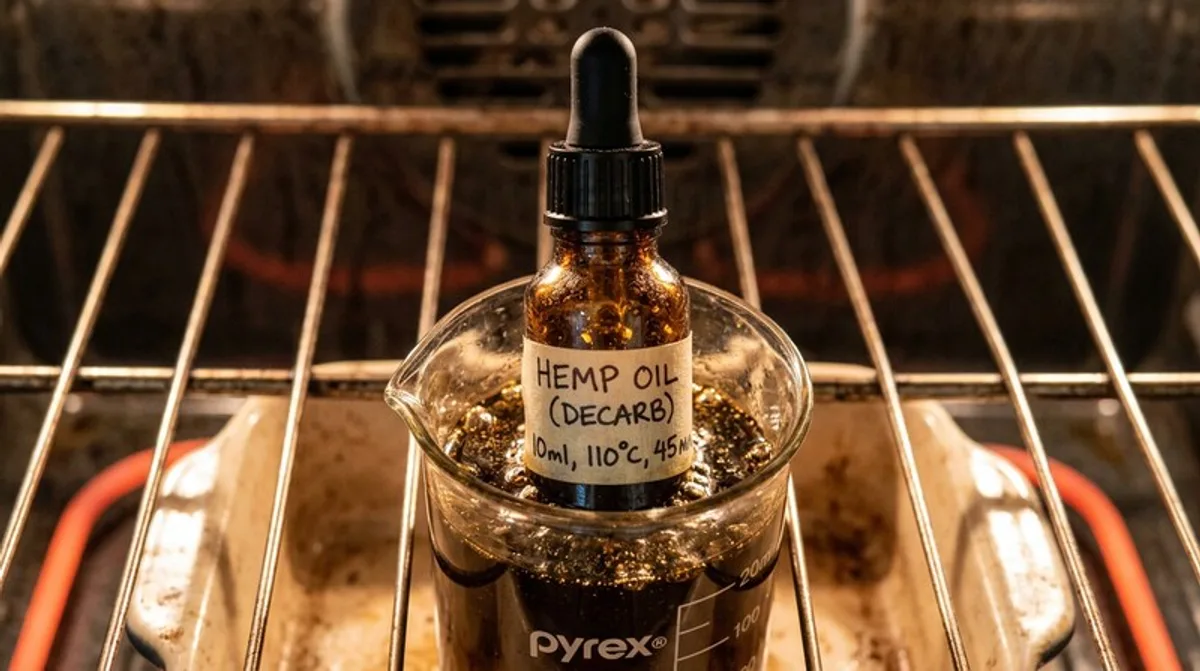
CBN (cannabinol) is a naturally occurring cannabinoid produced by the oxidative degradation of THC. When cannabis flowers are exposed to light, heat and oxygen, THCA gradually converts to CBNA, which becomes CBN through decarboxylation. Older, incorrectly stored cannabis therefore contains more CBN – which explains the well-known sedative effect of old cannabis samples.
CBN is the first cannabinoid ever isolated (1899, Wood et al.) and was long known as an inactive degradation product. However, more recent research shows its own pharmacological activity: CBN is a weak partial CB1 agonist (approx. 10 % of the potency of THC), binds to CB2 and interacts with several non-CB receptors.
CBN and sleep: the evidence base
| Study/Source | Design | Result |
|---|---|---|
| Steep Hill Labs 2017 (Popular claim) | Internal lab analysis, not peer-reviewed | 5 mg CBN = sedation strength 10 mg diazepam – NOT REPLICATED, REVIEWED |
| Corroon 2021 (Cannabis Cannabinoid Res) | Review, CBN pharmacology | No controlled human studies on CBN and sleep; sedation evidence is lacking in the literature |
| Karniol et al. 1975 (Psychopharmacologia) | n=5 subjects, CBN alone vs. CBN+THC | CBN alone hardly sedating; in combination with THC increased sedative entourage effect |
| Wong & Cairns 2019 (Cannabis Cannabinoid Res) | Animal model, CBN i.p. | CBN increases sleep time in mice; glutamatergic/GABAergic mechanism |
Conclusion on the evidence base: The popular comparison “5 mg CBN = 10 mg diazepam” comes from a non-peer-reviewed document and has never been replicated in studies. Animal models show sedative effects, but human studies are lacking. CBN may have sleep-promoting properties – but the extent is still open to scientific debate.
How CBN works: Mechanisms
CB1 partial agonism: CBN binds to CB1 with about 10 % of the activity of THC. This explains the mild sedation without a pronounced psychoactive effect.
TRPA1 activation: CBN activates the TRPA1 ion channel (Transient Receptor Potential Ankyrin 1), which is found in sensory neurons of the skin and respiratory tract. TRPA1 activation has analgesic and sleep-mediated effects in animal models.
Adenosine system: Indirect evidence of adenosine interaction – similar to CBD. Adenosine is the primary endogenous “sleep drive” mediator; higher levels of adenosine in the brain increase sleep pressure.
Entourage effect with THC: The strongest evidence for CBN sedation is when used in combination with THC. CBN appears to enhance THC-induced sedation – an entourage mechanism observed in full-spectrum extracts (older flowers with high CBN content).
CBN vs CBD vs THC: sleep comparison
| Cannabinoid | Sleep effect | Intoxication effect | Evidence |
|---|---|---|---|
| CBN | Mildly sedating, TRPA1/CB1-mediated | Minimal (partial agonist) | Animal models, no RCT |
| CBD | Anxiolytic, deep sleep promotion (high doses) | No intoxication | Several human studies |
| THC | Strong sedative, REM suppression | Psychoactive (CB1) | Well documented, rebound risk |
CBN products: What’s on the market
CBN oils and gummies are mainly offered on the American market. In Germany, CBN falls under the same legal gray area as other cannabinoids that are not explicitly prohibited:
- Legal classification DE: CBN is not a BtMG substance, but the EU Novel Food Regulation may apply. CBN from hemp extracts is in an unclear zone – unlike CBD, there is no EFSA dossier yet.
- Dosage (empirical): 5-25 mg CBN orally, 30-60 minutes before sleep. Due to low first-pass effect, sublingual may be more efficient.
- Prefer full spectrum: CBN shows stronger sleep effects in combination with other cannabinoids and terpenes (myrcene, linalool) than in isolation.
When CBN can be useful
CBN is interesting for people who:
- Have insomnia but want to avoid the psychoactive effects of THC
- CBD alone is not enough
- Looking for a natural alternative to synthetic sleeping pills
- Prefer full-spectrum extracts with a higher CBN content (older varieties)
For medical indications,
CBN: Effects & studies - Cannabis microdosing
FAQ: CBN and sleep
Summary
CBN is a degradation product of THC with mild CB1 partial agonist properties and an interesting sleep profile. Controlled human studies are still lacking, animal models show sedative effects. Unlike THC, there is no significant intoxication effect. In combination with other cannabinoids (entourage effect), CBN appears to have a stronger effect than in isolation. For clinical sleep disorders, the prescription remains the safer route; for supplementary sleep aid, full-spectrum CBN is a valid approach.