Cannabis edibles: effect, duration & dosage explained
- THC → 11-hydroxy-THC in the liver: up to 3× stronger, onset of action 45-90 min
- Oral bioavailability: 4-20 % – the same dose works completely differently in two people
- Adding after 45 min = most common mistake and almost always leads to overdose
Edibles: Why oral cannabis use feels so different
Cannabis edibles – cookies, gummy bears, brownies, oils, capsules – have completely different pharmacological kinetics than inhaled cannabis. What many people don’t know: THC taken orally is converted in the liver to a different substance that has a stronger, longer and different effect. This leads to the classic errors associated with edibles consumption.
Liver metabolization: THC becomes 11-OH-THC
When THC is taken orally, it enters the liver via the gastrointestinal tract – subject to the first-pass effect. In the liver, CYP2C9 and CYP3A4 convert THC to 11-hydroxy-THC (11-OH-THC):
– 11-OH-THC is significantly more psychoactive than THC itself
– 11-OH-THC crosses the blood-brain barrier even more efficiently than THC
– Blood plasma concentration of 11-OH-THC after oral ingestion: up to 3× higher than after inhalation
– Half-life of 11-OH-THC: longer than THC → prolonged duration of action
This explains why edibles have a more intense, heavier and longer-lasting effect – not because the dose is higher, but because a stronger metabolite is produced.
Pharmacokinetics: time course
| Parameters | Inhaled (Joint/Vaporizer) | Oral (edible/capsule) |
|---|---|---|
| Onset of action | 1-5 minutes | 30-120 minutes (faster on an empty stomach, slower but stronger with fat) |
| Peak effect | 10-30 minutes | 1-3 hours after ingestion |
| Duration of action | 1-3 hours | 4-8 hours (often longer at high doses) |
| Bioavailability | 25-56 % | 4-20 % (highly variable) |
| Active metabolite | THC (+ little 11-OH-THC) | THC + 11-OH-THC (significant amount) |
The most common mistake: topping up
The classic scenario: you eat an edible, wait 45 minutes, feel nothing, eat more. An hour later, both doses arrive at the same time – with full 11-OH-THC conversion. Result: overwhelming effect, panic, unpleasant high.
Golden rule: For edibles, wait at least 2 hours before topping up. If you are cannabis-sensitive: 3 hours.
Bioavailability: Why edibles are so unpredictable
The oral bioavailability of THC varies between 4 % and 20 % – depending on:
– Fat content of the meal: THC is lipophilic; up to 3× higher absorption with a meal containing fat
– Individual CYP2C9 activity: Genetic variants determine how quickly THC is metabolized
– Intestinal flora: Intestinal microbiomes modulate cannabis absorption
– Emulsion form: Nanoemulsified THC (water-soluble) has significantly higher and faster absorption
Dosage: recommendations for beginners
| Experience | Initial dose | Waiting time before refilling |
|---|---|---|
| Edibles for the first time | 2.5 mg THC | 3 hours |
| Occasional use | 5 mg THC | 2 hours |
| Experienced users | 10-15 mg THC | 2 hours |
| Medical (high tolerance) | 20-50 mg THC | individual |
What to do if the edible effect is too strong
Overdosing with edibles is unpleasant but not life-threatening. Helpful measures:
– Lying down: safe environment, breathing calmly
– Take CBD: CBD can mitigate the effects of THC (competitive CB1 interaction)
– Sugar: Dextrose can slightly shorten acute THC intoxication (anecdotal)
– Distraction: music, movie, quiet company
– Drink water (not alcohol)
– Effect subsides after 4-6 hours without intervention
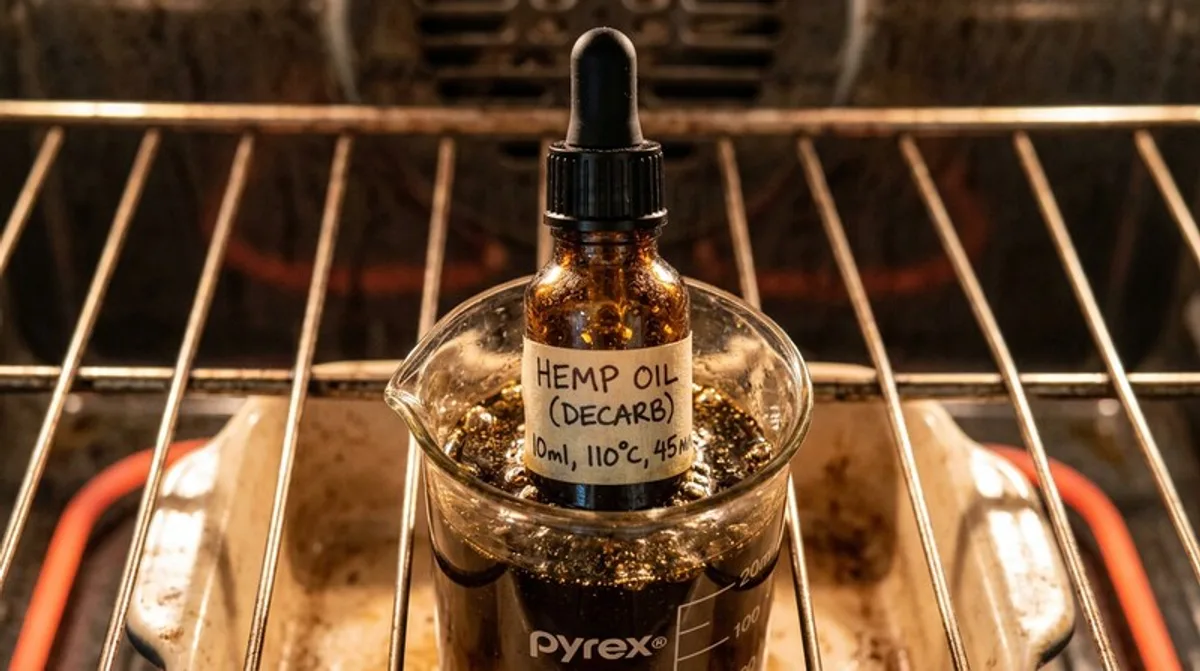
A comparison of forms of consumption - Cannabis decarboxylation
FAQ: Cannabis Edibles
Summary
Edibles have a stronger, longer and different effect than inhaled cannabis due to liver metabolization of THC to 11-OH-THC. Onset of effect 30-120 minutes, duration 4-8 hours. Starting dose 2.5-5 mg THC, 3 hours waiting time. Bioavailability is variable (4-20%) and fat-dependent. The most common mistake: topping up early. Variety guide for choosing the right flower; CBD dosage guide for medical use.

Cannabis for social anxiety: CBD & social phobia
Cannabis for restless legs: CBD, dopamine & studies
Cannabis & bones: CB2, osteoporosis & bone healing
Cannabis & testosterone: effect on male fertility
Cannabis quality: laboratory tests, pesticides & contamination

Retinol: effect, application and the best products for radiant skin