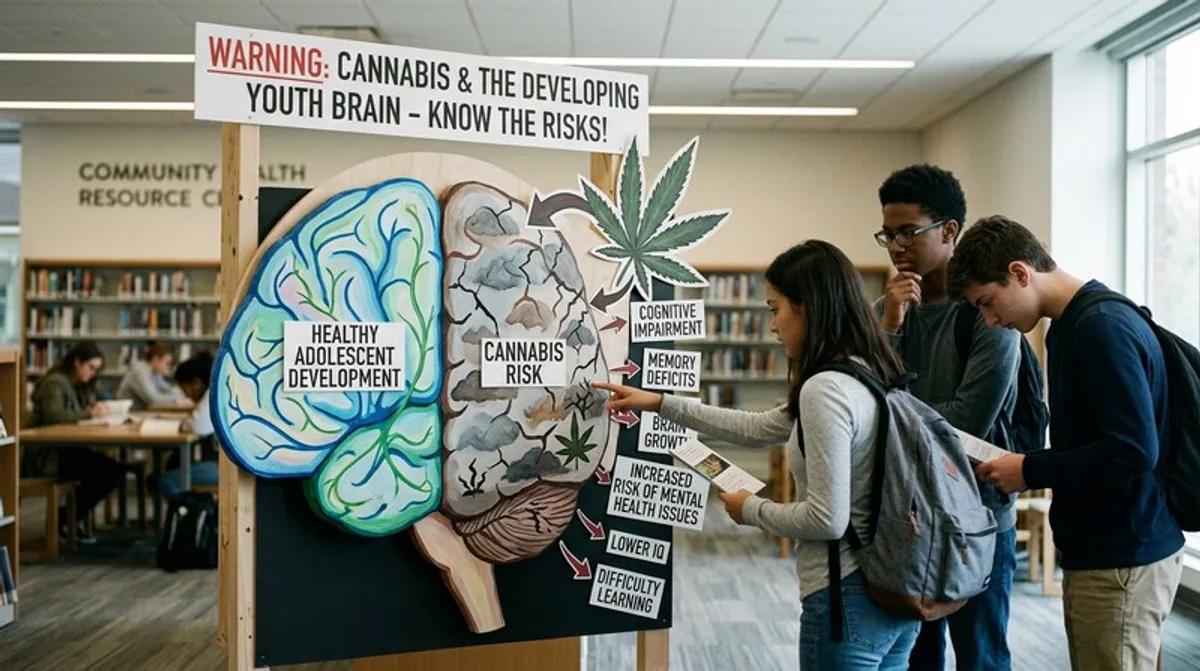
Cannabis and adolescents: Brain development & risks
- Brain development up to 25 – endocannabinoids control pruning and myelination, THC disrupts these processes
- Meier 2012 (n=1037): Onset before 15 = 8 IQ points loss by 38 – even after adjusting for social factors
- Adults who started after 18: no significant IQ loss – biological basis of the age limit
Why young people are particularly vulnerable
The brain continues to develop until around the age of 25 – the prefrontal cortex, hippocampus and limbic system mature through childhood and adolescence. The endocannabinoid system plays a crucial role in this development: endocannabinoids control neuronal migration, synaptic pruning processes and myelination. THC intervenes directly in this developmental process – what is reversible in adults can have lasting effects in the adolescent brain.
Neuroscientific mechanisms
Synaptic pruning: During the teenage years, excess synaptic connections are selectively eliminated (pruning) – controlled by endocannabinoids. THC disrupts this process and can lead to incorrect pruning patterns, especially in the prefrontal cortex.
Loss of hippocampal volume: THC inhibits neurogenesis in the hippocampus – particularly harmful in adolescents with active growth. MRI studies show lower hippocampal volume in early users.
Dopaminergic system: Chronic THC in the adolescent brain leads to stronger CB1 downregulation in the mesolimbic system than in adults – which can explain lack of motivation and increased risk of addiction.
Study situation: Cannabis and adolescent brain development
| Study | Design | Result |
|---|---|---|
| Meier et al. 2012 (PNAS) | Dunedin longitudinal study, n=1,037, onset of use <18 vs. adult, 38 years follow-up | Early users (<18): -8 IQ points at 38 years; no loss at onset of use in adulthood; persists despite abstinence |
| Gruber et al. 2021 (Psychol Med) | Longitudinal section, n=140, early vs. late consumption, fMRI | Early use associated with deviant frontal activation, attention deficits; cognitively significantly worse |
| Di Forti et al. 2019 (Lancet Psychiatry) | European multicenter study, n=901 psychotic episodes | Daily cannabis use: 3.2× higher risk of psychosis; high potency (>10% THC): 4.8× higher risk; early onset increases effect |
| Brook et al. 2011 (J Child Psychol Psychiatry) | Longitudinal section, n=1,003, youth to adulthood | Early adopters: higher school drop-out rate, lower income, more mental illnesses in adulthood |
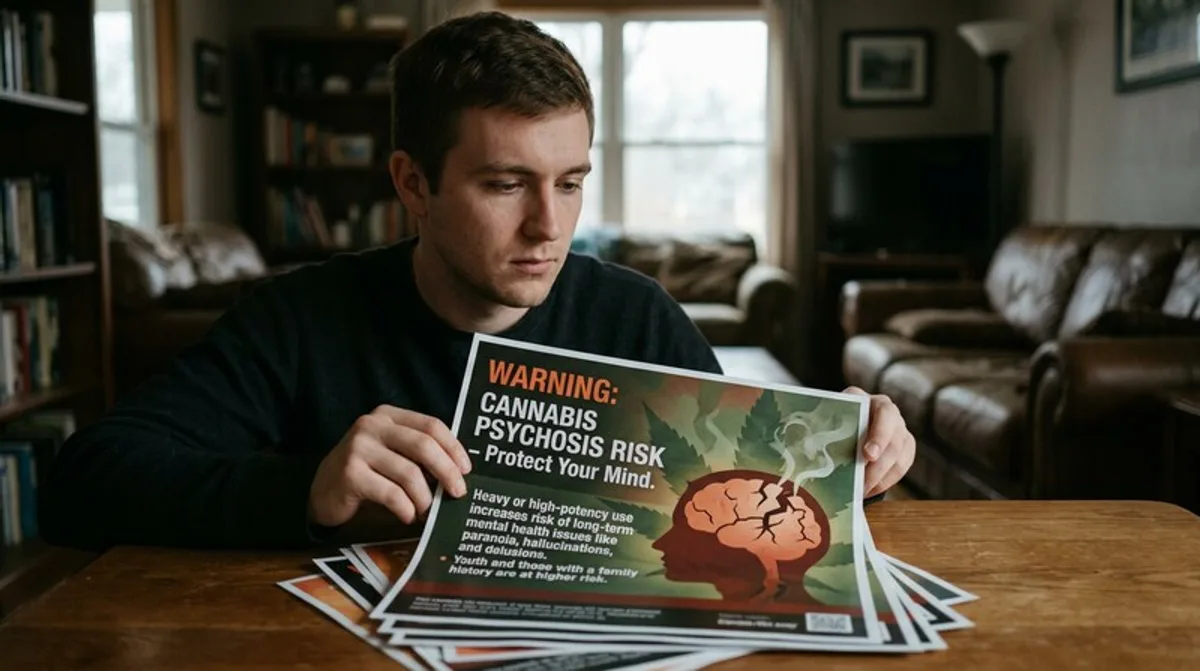
Risk of psychosis: The most important findings
The increased risk of psychosis due to cannabis is the most clinically significant finding – and is greatest among adolescents:
– Di Forti 2019 (Lancet): Daily high-potency cannabis use → 4.8× higher risk of psychosis
– Adolescents with a family history of schizophrenia have an extremely high risk of cannabis use
– The risk is not just correlation – dose-response relationship and biological plausibility evidence (CB1 overactivation in dopaminergic pathways) support causality


IQ loss: real risk or confounder?
The Meier study (PNAS 2012) has been widely discussed. Criticism: social factors could explain IQ loss. Counterargument: Dunedin study controls for socioeconomic status; adopted siblings show similar patterns; -8 IQ points is clinically functionally significant.
More recent studies (Jackson et al. 2016) put this into perspective: when controlling for pre-cannabis IQ, the effect is smaller, but not zero.
What applies to young consumers
The legal situation in Germany sets the age of consent at 18 years. The following applies to adolescents and young adults:
– No cannabis under the age of 18 – this consensus is undisputed in all disciplines
– Between 18-21: lower THC limit in cannabis social clubs (max. 10 g/month, max. 10 % THC) – enshrined in law
– Between 21-25: Risks are lower than for teenagers, but daily high-potency cannabis is still problematic
- Cannabis addiction
Lowering THC tolerance
FAQ: Cannabis and young people
Summary
Cannabis and adolescents is the most important cannabis risk chapter. The adolescent brain up to the age of 25 is particularly vulnerable due to ECS-driven maturation processes. Early use (<18 years) is associated with IQ loss (Dunedin study: -8 points), increased risk of psychosis (4.8× with high potency) and long-term cognitive deficits. Absolute age of consent 18, reduced THC limit up to 21 legally enshrined in Germany. Related: Cannabis and psychosis risk and cannabis dependence as associated risks of early use.

Cannabis for restless legs: CBD, dopamine & studies
Cannabis & bones: CB2, osteoporosis & bone healing
Cannabis & testosterone: effect on male fertility
Cannabis quality: laboratory tests, pesticides & contamination

Home cannabis cultivation: rules according to CanG
Cannabis microdosing: low doses of THC & CBD