Tag Archive for: Medical cannabis

Cannabis for back pain: CBD, THC & intervertebral discs

The most important thing: Chronic back pain has four types of pain (nociceptive, neuropathic, myofascial, centralized) – cannabis attacks all four at the same time. 70% of patients report a strong reduction. And: cannabis can reduce opioid requirements by 44 %. At a glance: Cannabis simultaneously targets all 4 types of pain: nociceptive, neuropathic, myofascial, […]

Cannabis for social anxiety: CBD & social phobia

Most importantly, social anxiety is the best clinically proven cannabis indication. Bergamaschi 2011 (RCT): CBD 600 mg measurably halved anxiety, cognitive impairment and physiological stress during public speaking. THC, on the other hand, can increase social anxiety. At a glance: Bergamaschi 2011 (RCT): CBD 600 mg halved anxiety, cognitive impairment and stress Optimal dose: 300 […]

Cannabis for Crohn’s disease: CBD, remission & studies

Most important: Naftali 2013 – the first RCT on cannabis in Crohn’s disease – showed 45% full remission with THC cannabis versus 10% placebo. CBD alone was not sufficient for remission induction. THC component is crucial for Crohn’s disease. At a glance: Naftali 2013 (RCT): 45 % full remission with cannabis vs. 10 % placebo […]

Cannabis for restless legs: CBD, dopamine & studies

The most important thing: Restless legs syndrome (RLS) affects 5-10% of the population and is often resistant to treatment. Cannabis intervenes directly in RLS pathophysiology via dopaminergic modulation (CB1 in basal ganglia) and spinal pain processing (TRPV1). At a glance: RLS affects 5-10% of the population and is treatment-resistant in many cases Ghorayeb 2020: 6 […]

Cannabis & bones: CB2, osteoporosis & bone healing

The most important thing: CB2 receptors – the non-psychoactive cannabinoid receptor class – are located directly on osteoblasts and osteoclasts. CB2 activation promotes bone formation and inhibits bone resorption. CBD significantly accelerated fracture healing in animal models. At a glance: CB2 receptors are located directly on osteoblasts (bone formation) and osteoclasts (bone resorption) CB2 knockout […]

Cannabis for ADHD: THC, CBD & concentration – Studies

Most important: 20-30% of all adults with ADHD self-medicate with cannabis. Pharmacologically plausible: ADHD is associated with anandamide deficiency, CB1 directly modulates dopamine. Survey data shows 55% report better concentration. At a glance: 20-30% of all adults with ADHD self-medicate with cannabis Mechanism: ADHD is associated with anandamide deficiency – CB1 directly modulates dopamine For […]

Cannabis in palliative care: pain & quality of life

The most important thing: cannabis reduces the need for opioids in palliative patients by a median of 44% (Mechnik 2018). Dronabinol and nabilone are approved for chemotherapy nausea. Since 2017 on BtMG prescription with SHI reimbursement option. At a glance: Dronabinol (THC) and nabilone are officially approved for chemotherapy nausea Cannabis reduces the need for […]

Cannabis during the menopause: CBD, hormones & studies

The most important thing: oestrogen directly regulates anandamide levels in the brain. If oestrogen falls during the menopause, anandamide also falls – which explains hot flushes, sleep disorders and mood swings neurobiologically. At a glance: Oestrogen directly regulates anandamide levels – menopause = ECS dysregulation 79% of women surveyed report symptom relief from cannabis (Dahlgren […]

Cannabis for irritable bowel syndrome: IBS, CBD & intestinal pain

Most importantly, IBS affects 10-15% of the population. IBS patients have increased FAAH activity and lower anandamide levels in the intestine – a measurable ECS deficit directly at the site of the symptoms. At a glance: IBS patients have increased FAAH activity and lower anandamide levels in the gut – measurable ECS deficit CB1 on […]

Cannabis for endometriosis: pain, CBD & study situation

Most importantly, endometriosis lesions express CB1 and CB2 at lower levels than normal endometrium – an ECS hypoactivity directly at the pathology site. CBD inhibited proliferation and invasion of lesions in vitro (Bouaziz 2017). At a glance: Endometriosis lesions express CB1 and CB2 – ECS directly involved in pathophysiology CBD inhibited proliferation and invasion of […]

Cannabis for psoriasis & eczema: CBD topical & ECS

Most importantly, the skin is one of the tissues most densely endowed with ECS components. CB2 on keratinocytes and mast cells regulates inflammation, proliferation and sebum – all of which are dysregulated in psoriasis. At a glance: CB2 on keratinocytes and mast cells regulates inflammation, proliferation and sebum directly in the skin CBD significantly inhibited […]

Cannabis for Parkinson’s: tremor, dopamine & ECS studies

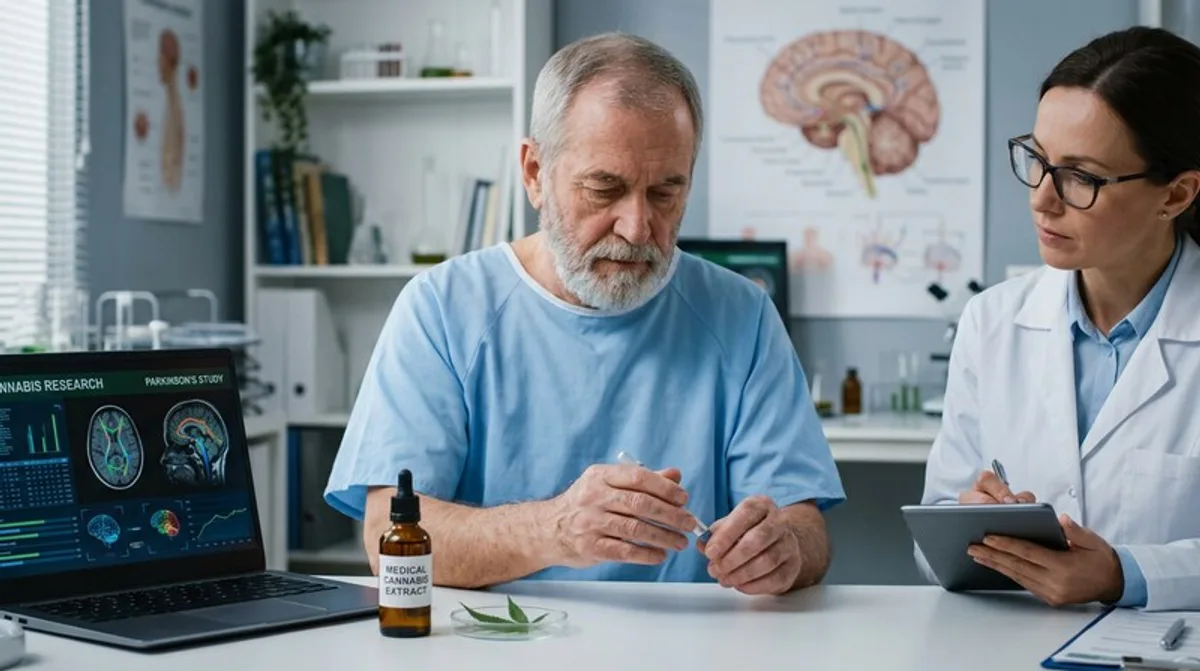
The most important thing: CB1 is particularly dense in the striatum, globus pallidus and substantia nigra – precisely the structures that degenerate in Parkinson’s disease. Lotan 2014 (n=22): Cannabis reduced tremor by -31% and pain by -45%. At a glance: CB1 is particularly dense in the striatum, globus pallidus and substantia nigra – at the […]

Cannabis and cancer: anti-tumor research & reality

Key points: In vitro and in animal models, cannabinoids inhibit tumor growth, angiogenesis and metastasis. In humans: no clinical evidence for cancer cure. Cannabis in cancer is well documented for symptom control (pain, nausea, appetite). At a glance: In vitro: Cannabinoids inhibit tumor growth, angiogenesis and metastasis in dozens of cell lines Guzman 2006: Intratumoral […]

Cannabis for autism: CBD, ASD & behavioral studies

Most important: ASD patients have altered endocannabinoid levels and CB1 expression. Aran 2019 (n=60): CBD-rich cannabis oil (80% CBD, 1% THC) improved behavioral problems in 74% of children. At a glance: ASD patients show lower anandamide levels and altered CB1 expression Aran 2019 (n=60): 74% of children showed improvement in behavioral problems with CBD-rich oil […]

Cannabis for diabetes: blood sugar, insulin & ECS

Most importantly, cannabis users paradoxically have 16% lower fasting insulin levels and 17% lower insulin resistance than non-users (NHANES, n=4657). The ECS is directly integrated into glucose metabolism. At a glance: Paradox: Cannabis users have 16% lower insulin levels despite increased appetite (Penner 2013) CB1 and CB2 on pancreatic beta cells – cannabis intervenes directly […]

Cannabis for nausea: chemo, antiemetic & studies

Most important: Dronabinol (synthetic THC) received FDA approval in 1985 for chemotherapy nausea – one of the oldest medical cannabis indications. CB1 in the vomiting center (area postrema) directly inhibits the serotonergic nausea signaling cascade. At a glance: Dronabinol FDA-approved for chemotherapy nausea since 1985 – one of the oldest cannabis indications CB1 in the […]