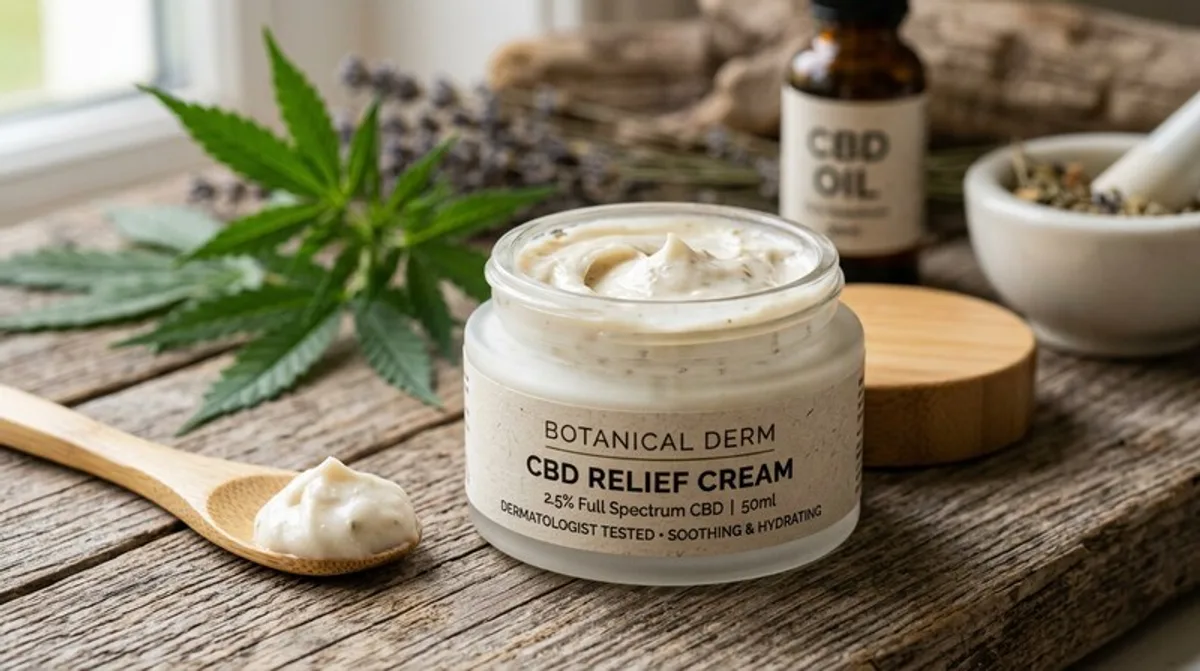
Cannabis for psoriasis & eczema: CBD topical & ECS
- CB2 on keratinocytes and mast cells regulates inflammation, proliferation and sebum directly in the skin
- CBD significantly inhibited keratinocyte proliferation in vitro – direct effect on psoriasis pathomechanism
- Topical CBD: penetrates the epidermis and acts locally via CB2, TRPV1 and PPAR-γ without a systemic effect
The endocannabinoid system in the skin
The skin is the largest organ of the body and one of the tissues most densely endowed with ECS components. CB1, CB2, TRPV1, TRPV4 and PPAR-γ are detected in keratinocytes, melanocytes, hair follicles, sebaceous glands, mast cells and nerve fibers of the skin. The cutaneous ECS regulates:
– Proliferation and differentiation of keratinocytes (skin renewal)
– Sebum production (sebaceous glands via CB2)
– Inflammatory reactions (mast cells, T cells)
– Itch signal chain (TRPV1 in sensory nerve fibers)
– Barrier function of the epidermis
Dysregulation of the cutaneous ECS is associated with psoriasis, atopic dermatitis (neurodermatitis), acne and chronic pruritus.
CBD for psoriasis: mechanism and studies
Psoriasis is an autoimmune-mediated inflammatory skin disease with keratinocyte hyperproliferation. CBD acts on several levels:
Antiproliferative: Wilkinson & Williamson 2007 (J Dermatol Sci): CBD inhibits keratinocyte proliferation in a concentration-dependent manner via TRPV1 activation and CB1 inhibition of the EGF receptor.
Anti-inflammatory: CBD reduces TNF-α, IL-6, IL-1β – all key cytokines in psoriasis – in keratinocytes and mast cells. CB2 activation inhibits T-cell activation in the psoriasis circuit.
| Study | Design | Result |
|---|---|---|
| Wilkinson & Williamson 2007 (J Dermatol Sci) | In vitro, keratinocytes, CBD | CBD inhibits keratinocyte proliferation at 0.1-10 µM; no toxicity; TRPV1-dependent |
| Palmieri et al. 2019 (Clin Ther) | Observational study, n=20, CBD cream for psoriasis and atopic dermatitis, 3 months | Significant improvement in skin hydration, elasticity, itching and sleep quality; no patient without improvement |
| Biro et al. 2009 (Trends Pharmacol Sci) | Review, cutaneous ECS | CB2 agonists in T cells inhibit psoriasis inflammatory cascade; topical ECS targeting proven as a therapeutic principle |
CBD for neurodermatitis (atopic dermatitis)
Atopic dermatitis is characterized by a defective skin barrier, chronic inflammation and intense itching. CBD addresses all three:
Barrier function: PPAR-γ activation by CBD stimulates ceramide synthesis → improved epidermal barrier. Ceramide deficiency is a core defect in atopic dermatitis.
Itching (pruritus): TRPV1 in cutaneous nerve fibers mediates itch signals. CBD desensitizes TRPV1 → itch reduction without antihistamine side effects.
Inflammation: IL-4, IL-13 (Th2 cytokines in atopic dermatitis) are reduced by CB2 activation – similar mechanism as with dupilumab (biologic antibody).
Topical CBD vs. systemic CBD for skin diseases
For skin diseases, topical CBD (cream, serum, ointment) makes more sense than systemic administration:
– High local concentration directly on the target tissue
– No systemic effect (no degradation via liver, no CYP interactions)
– Systemic bioavailability very low (<1 %), locally sufficient for keratinocyte effect
Quality criteria for CBD skin products:
– COA-tested CBD content (often declared too low or too high)
– Liposomal or nanoemulsified formulation increases skin penetration
– No alcohol carrier for neurodermatitis (drying)
– Ceramides and panthenol as additional barrier supporters
Cannabis & the immune system - Comparison of forms of consumption
FAQ: Cannabis for skin diseases
Summary
Cutaneous ECS is one of the best understood and most accessible ECS areas. CBD has an antiproliferative effect on keratinocytes (psoriasis), an anti-inflammatory effect via CB2/TRPV1 and reduces itching via TRPV1 desensitization (neurodermatitis). Topical CBD is more useful for skin diseases than systemic use – high local concentration, no interactions. CBD dosage guide for systemic use for comorbidities; check interactions with dermatologicals (cyclosporine, methotrexate) with a doctor.
K-Beauty products in Germany: The best brands & stores

Cannabis for back pain: CBD, THC & intervertebral discs

Cannabis for social anxiety: CBD & social phobia
Cannabis for Crohn's disease: CBD, remission & studies
Cannabis for restless legs: CBD, dopamine & studies
Cannabis & bones: CB2, osteoporosis & bone healing