





















Cannabis and driving: THC limit and driver's license risk
The legalization has raised a pressing question: When is it permissible to drive after cannabis consumption? The answer is more complicated than with alcohol — and since legalization, the…
Contents
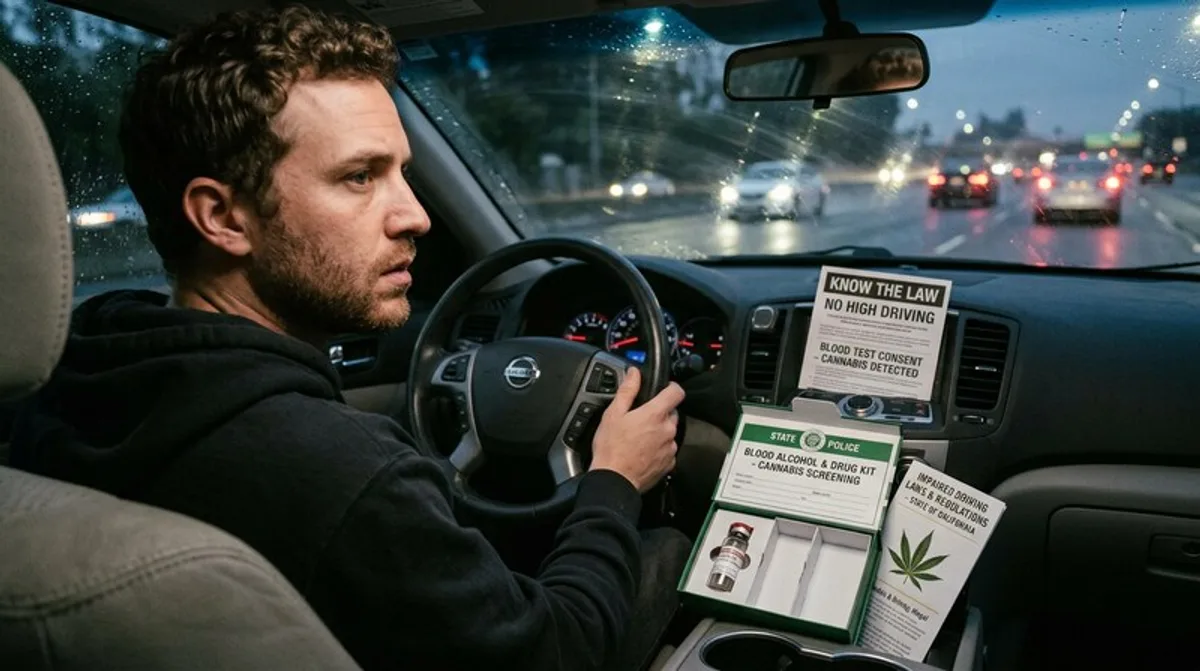
The legalization has raised a pressing question: When is it permissible to drive after cannabis consumption? The answer is more complicated than with alcohol — and since legalization, the legal framework has been revised. What applies since 2024, what are the consequences, and why the new limit is controversial.
The new THC limit: 3.5 ng/mL blood serum
With the KCanG (Cannabis Act, 2024), §24a of the Road Traffic Act was also reformed:
- Previous situation: Any detection of THC in the blood above 1 ng/mL was considered an offense — even if the person was no longer intoxicated
- New limit (since 22.08.2024): 3.5 ng/mL THC in blood serum as the threshold for an offense. Below that: no offense, if no impairment is detected
- Recommendation of the limit commission: The value of 3.5 ng/mL is based on scientific recommendations — it is compared to a blood alcohol concentration of 0.2 per mille (the lower end of intoxication)
- Fine: First offense above 3.5 ng/mL: 500 euros, 1 point in Flensburg, 1 month driving ban. Repeat offenses are significantly higher
- Criminal law: Anyone who causes an accident under the influence of cannabis or is clearly unfit to drive can be held criminally liable — regardless of the limit (§§ 315a/316 Crim. Code)
Cannabis and Alcohol Combination: Zero Tolerance
Stricter rules apply to mixed consumption:
- Anyone who has both alcohol (from 0.5 per mille) AND cannabis (from detection) in their blood commits a qualified traffic offense — significantly higher fines and longer driving bans
- For novice drivers on probation, there is an absolute ban on alcohol AND cannabis use (0.0 tolerance)
- The combination of cannabis and alcohol is particularly risky pharmacologically — alcohol increases THC plasma concentration and intensifies the impairing effects
The Core Problem: Detection Duration vs. Effect Duration
What makes alcohol limits simple is complex when it comes to cannabis:
- Alcohol: The correlation between blood alcohol concentration and driving impairment is well documented and linear. Measurable, predictable
- THC: No linear correlation between THC blood concentration and driving impairment. The effect occurs at much lower concentrations than the detection threshold and decreases more rapidly than THC leaves the blood
- Detection window after consumption (blood serum):
- Single use: THC below 3.5 ng/mL typically 4–8 hours after inhalation
- Regular users: THC can still be detectable for days after use without active intoxication — 3.5 ng/mL can still be present in chronic users even after 24+ hours
- Carboxy-THC (drug test metabolite): Detectable in urine for 3–30+ days — not relevant for blood tests, but used for roadside saliva tests
- Problem for chronic users: A user who has consumed cannabis daily for weeks and then is abstinent for a week can still have more than 3.5 ng/mL — without any acute intoxication
Roadside tests: How police test
What happens during a traffic stop:
- Observation: Red eyes, slowed reaction, balance problems, unusual behavior — police can request a drug test independently of suspicion or during a random check
- Saliva rapid test: Roadside test for THC in saliva — positive result: taken to a blood draw. Saliva test is a screening, not evidence
- Blood draw: The only reliable test. Blood is analyzed for THC in serum. The person concerned bears the cost in case of a positive result
- Refusal: Blood draw cannot be refused — refusal may lead to more severe consequences
MPU: Medical-Psychological Assessment
When the driver’s license office intervenes:
- For first-time offenders with more than 3.5 ng/mL and a fine: no automatic MPU
- MPU ordered if there are indications of regular consumption + driving, multiple violations, or if the driver’s license was revoked by a court
- Passing the MPU with cannabis use: proof of abstinence through regular urine or hair tests over 6–12 months required
- Who drives with a driver’s license and consumes cannabis should strictly separate both — temporally and psychologically
Practical Recommendations
- For occasional users: Wait at least 8–12 hours after inhalation before starting to drive. For heavy use or edibles, wait 24+ hours
- For regular users: THC levels are not reliably predictable — in doubt, do not drive. Use public transport or a taxi
- Medical cannabis patient: Special status is possible under certain conditions — the doctor must confirm driving fitness. Driving spontaneously after consumption remains risky
- No “safe” time for everyone: Individual tolerance and metabolism make general time recommendations unreliable
How long THC can be detected in blood and urine: