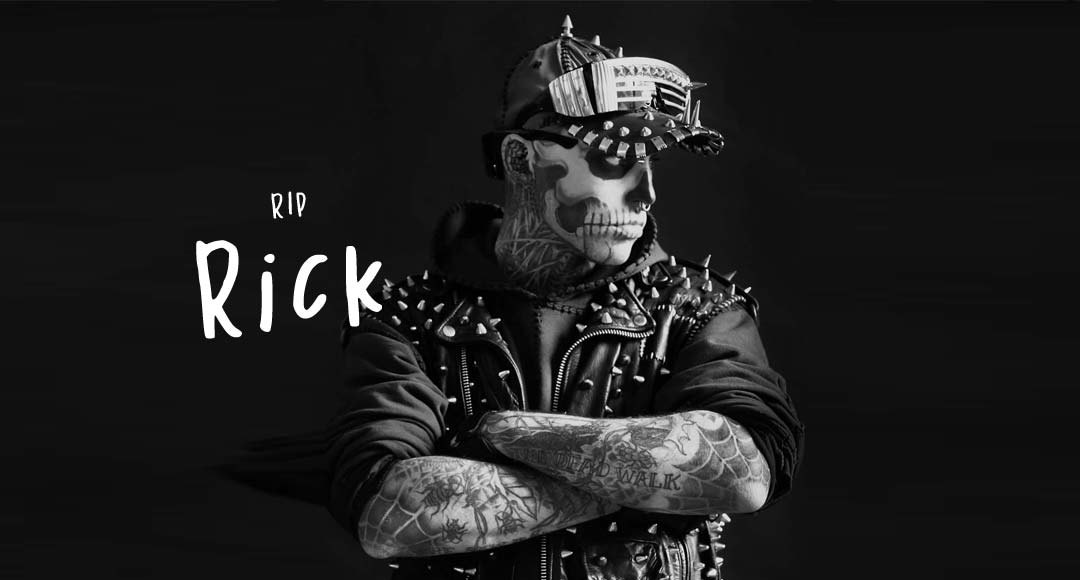
Zombie Boy aka Rick Genest dead (†32) in his apartment – our last interview
176 insects. 139 human bones. A brain tumor with 15. And a fall from the balcony, which to this day still fluctuates between suicide and accident — although the coroner has long made a decision. Rick Genest, internationally known as Zombie Boy, was found dead in his apartment in Le Plateau-Mont-Royal in Montreal at the age of 32, six days before his 33rd birthday. We met him personally two years earlier — and our last interview reads today almost painfully prophetic.
What remains unclear about his death to this day: The official classification from the Bureau du coroner du Québec ultimately did not label it as suicide, but as an accident. The tabloid media had already printed other headlines — and this correction loop is the most important story around Rick Genest, which hardly anyone tells.
Suicide or accident? What the coroner’s report really revealed
Within hours of the body being found, the Service de police de la Ville de Montréal released a clear version: Rick Genest had jumped from the balcony of his apartment on the sixth floor. Suicide. This initial report spread through global news tickers before anyone checked the sources. Lady Gaga, who had made Genest a global star in her music video for “Born This Way,” tweeted an emotional statement — and implied that his death was a suicide.
Days later, the story changed. Family members and close friends publicly contradicted it. Lady Gaga later apologized for her initial reaction, as she had prematurely assumed suicide as a fact — a media ethically significant moment that is often overlooked in most obituaries. Frances Bean Cobain, who was friends with Genest and has a particularly sensitive connection to the topic due to the suicide of her father, Kurt Cobain, also publicly expressed doubts.
The final report from the Bureau du coroner du Québec classified Genest’s death as accidental — an accident, not a suicide. The reconstruction suggested a fall, likely while handling a cigarette on the balcony railing. No farewell letter, no announcement, no prior attempts. A piece of information that barely reached anyone anymore, as the headlines had long since moved on.
“The science of mental health is not perfect. But we have to tell people who are struggling: You are not alone.” — Lady Gaga, days after Rick’s death
The Most Important Facts About Rick Genest’s Death at a Glance
- ✓ Death on August 1, 2018, in Le Plateau-Mont-Royal, Montreal
- ✓ Fall from the balcony of his sixth-floor apartment
- ✓ First police report: suicide
- ✓ Final coroner’s report: accident, not suicide
- ✓ Lady Gaga revised her initial public assessment
- ✓ Family and Frances Bean Cobain refuted the suicide theory
- ✓ Six days before his 33rd birthday
The Brain Tumor at 15: Why the Anatomy on His Skin Was No Fashion Statement
Here lies the most important fact that almost every generic obituary leaves out: Rick Genest survived a brain tumor as a teenager. The diagnosis came at 15, the surgery left a scar on his skull — and a confrontation with his own mortality. From this experience grew not the desire to look “extreme,” but the desire to make his own skeleton visible. Anatomy as a memento mori, not as a shock.
Genest, born on August 7, 1985, in LaSalle, Montreal, was trained as a sideshow performer before his modeling breakthrough. He performed at “Carnival Diablo,” swallowed light bulbs, had nails hammered into his nose. Whoever sees the later Mugler runway easily forgets: This man came from a tradition that dates back to the 19th century — freak show, punk, carnival. His first tattoo, a Jolly Roger, he tattooed himself at 16. At 19, he decided to transform his entire body into a walking corpse — anatomically correct, according to medical blueprints.
Tattoo artist Frank Lewis worked on the bones using anatomy atlases, not comics. The insects come, among others, from Maxime Buchi. Over two dozen artists were involved in total. Exactly this collaborative level of detail distinguishes Genest from any other “extreme” tattoo model.
Stylist Nicola Formichetti — back then Creative Director at Mugler and Lady Gaga’s closest confidant — discovered Rick on Facebook. Not through an agency, not through a casting. A direct social media message. What followed was perhaps the steepest rise any male model has ever had: from squatting in Montreal to walking in a Mugler show in Paris within a few weeks. Those interested in the classic way into the business will find concrete tips on becoming a model, on model casting, on model applications, and on current model jobs with us. Those who want to take the international route should read our guide to international modeling in New York, London and Paris. Rick Genest’s story, however, shows: sometimes a single Facebook contact can break every classic booking logic.
Rick Genest’s Career at a Glance
- Brain tumor surgery at 15 — trigger for the anatomical visual language
- Sideshow performer at Carnival Diablo, Montreal
- First tattoo at 16, full transformation from 19
- Discovered by Nicola Formichetti via Facebook
- Mugler debut as opening model of the Menswear Show
- „Born This Way” with Lady Gaga in the same year
- Dermablend ad with over 27 million views in the first weeks
- L’Oréal campaign cover — tattoos completely covered
- Movie roles in „47 Ronin” and „Carny”
The three campaigns that wrote fashion history
Three appearances made Rick Genest a global icon — and each one broke the format of its respective industry. What makes this list so special: It spans three completely different industries (Couture, Pop, Mass-Market-Beauty) and changed something fundamental in each. Little known: Lady Gaga’s iconic skull makeup in the „Born This Way” video was created only after Formichetti showed her Genest. She copied his face — not the other way around.
| Campaign / Appearance | Industry | Significance |
|---|---|---|
| Mugler Menswear (Nicola Formichetti) | Couture | First runway, opening of the show |
| Lady Gaga “Born This Way” | Pop / Music Video | Global breakthrough, over 1 billion YouTube views |
| Dermablend “Go Beyond the Cover” | Beauty | 27 million views in two weeks — viral milestone |
| L’Oréal Paris Cover Campaign | Mass-Market Beauty | Tattoos completely covered with makeup |
| Film roles “47 Ronin”, “Carny” | Hollywood | Transition into acting |
Especially the Dermablend spot was culturally groundbreaking. Over 27 million views in the first two weeks — a number that was unheard of in the pre-TikTok era and permanently changed beauty advertising. The message “It is what it is, until it isn’t” became a motto for a generation that renegotiated beauty. Anyone who finds the connection between fashion, makeup, and identity fascinating should take a look at ZOEVA and Dior Beauty — both work today with a visual language that would be hard to imagine without Genest’s pioneering work.
Why the L’Oréal campaign was the real breakthrough
A man whose entire face is a skull is made into a completely “normal” man through makeup — and then ultimately revealed again. Genest was not the object of the campaign. He was its creator. Exactly this mixture of punk attitude and obsessive precision made him so attractive to designers like Thierry Mugler and brands like Diesel. Also Gucci, Prada and other houses listed in our overview of fashion brands A–Z were looking for models who were not interchangeable during this phase — Rick was the exact opposite of interchangeable. Those who want to dive deeper into this brand world will find dedicated collections for the fashion brands with D, the fashion brands with P and the fashion brands with Z.


Mental Health: The Born-This-Way-Foundation Effect After Rick’s Death
What happened after August 1, 2018, is medically and historically significant. Lady Gaga’s Born This Way Foundation, which she had co-founded with her mother Cynthia Germanotta, intensified its mental health programs measurably. The Council for Inclusion in Communications, a program focus of the foundation, expanded its school initiative. Genest was never an official ambassador — but became one posthumously through pure symbolic power.
The central lesson of his case for newsrooms worldwide: In cases of high-profile deaths, suicide must never be hastily reported as the cause. The WHO recommendations on suicide reporting (no sensational style, no method details, always include help resources) were retrained in several major newsrooms after the Genest case. As we show in our overview on User Generated Content and its ethical dimensions, the viral spread of initial reports on social networks also significantly contributes to the solidification of misinformation — a mechanism that became particularly clear in the Genest case.
At a glance: The lessons from the correction loop
- ✓ Police reports are not medical findings
- ✓ Coroner reports often appear months later — news tickers don’t wait
- ✓ Celebrity condolence posts can reinforce misinformation
- ✓ Family is the most reliable source, not the tabloid press
- ✓ WHO standards for suicide reporting apply to fashion media as well
The Guinness Records — and why they are misunderstood
Rick Genest held two official Guinness World Records. Unlike most records in this category, his did not focus on sheer quantity, but on anatomical precision. His body was not a shock tapestry, but a scientific study in ink. Anyone who understands this sees the man behind the mask completely differently.
The facts that no generic obituary includes
- ✓ Most insects tattooed on the body: 176 insects, anatomically correct
- ✓ Most human bones tattooed on the body: 139 bones, according to medical atlases
- ✓ Over 24 hours of pure tattooing time, spread over numerous sessions
- ✓ Estimated total cost: over 8,000 US dollars
- ✓ Tattoo artist Frank Lewis worked with medical anatomy templates
- ✓ Brain tumor surgery as a biographical trigger for the anatomical visual language
Why Rick Genest changed men’s fashion forever
Rick Genest has changed men’s fashion in a more sustainable way than it seems at first glance. Before him, the male top model was a smooth, interchangeable face. After him, the industry opened up to characters, to tattooed individuals, to people with a story. Anyone who today looks at the castings of major houses during the Fashion Week Milan or the men’s lookbooks at Dolce & Gabbana sees traces of this paradigm shift everywhere. Even in casting formats like GNTM, the space for unconventional faces has measurably expanded — as the current GNTM season 21 (2026) with Jean Paul Gaultier impressively shows, who stands for a similarly boundary-breaking aesthetic as Genest.
Also in the stre

Infused Kitchen at FIV: The new cannabis cooking portal

Cannabis Drinks: Smoothies, Tea, Golden Milk & Recipes

Cannabis Grillen: BBQ, Marinaden & Rezepte für den Sommer
Infused Kitchen: Cannabis recipes for baking, cooking, grilling & drinks

Social Media Ads: More Sales Through Targeted Online Marketing

Career start after studies: What recruiters are really looking for