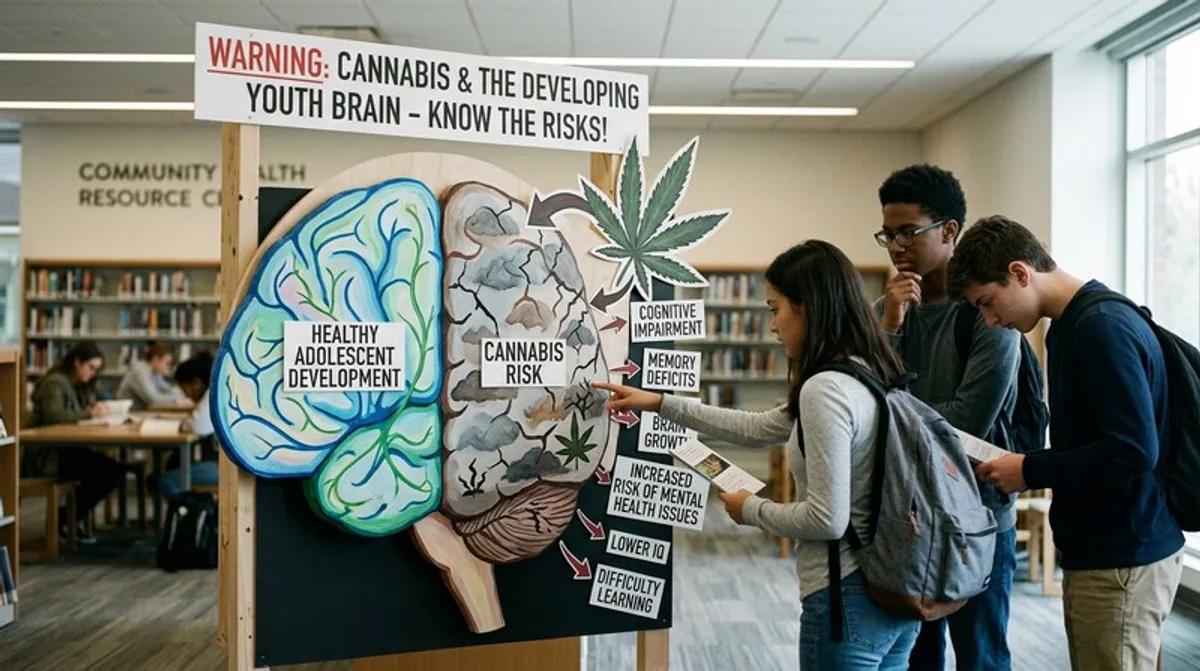
Cannabis and Teenagers: Risks for Brain Development
Cannabis is legal in Germany for adults since 2024 — this explicitly does not apply to young people. The KCanG has strengthened, not relaxed, youth protection. Why this is neurobiologically justified: The adolescent brain is still developing until about the age of 25, and THC directly interferes with this process.
The adolescent brain and the endocannabinoid system
The endocannabinoid system (ECS) is not a passive receptor system — it actively controls brain development. During adolescence, the density of CB1 receptors in the prefrontal cortex is at its highest. Exactly this area is not fully developed until about the age of 25 and is responsible for:
- Impulse control and decision-making
- Working memory and executive functions
- Emotion regulation
- Social judgment
THC binds to CB1 receptors and disrupts the natural signaling pattern of endocannabinoids (anandamide, 2-AG) in adolescence, which are necessary for synaptic pruning and myelination. Animal models show that chronic THC consumption during puberty permanently alters the neural architecture.
What studies show: Cognition and IQ
The most well-known long-term study on the subject is the Dunedin cohort (Meier et al., 2012, PNAS): 1,037 people, observation period from birth until 38 years. Result:
- Who started daily cannabis use 18 years ago lost an average of 8 IQ points by adulthood
- Wer erst im Erwachsenenalter begann, zeigte keinen signifikanten IQ-Verlust
- The effect was not fully reversible in adulthood when abstaining.
Limitations of the study were discussed (Socioeconomic Confounders, Rogeberg 2013), but follow-up studies have basically confirmed the finding — with smaller effect sizes, but consistent direction.
Weitere robuste Befunde:
- School performance: Daily cannabis use in school is associated with significantly worse grades (Fergusson, Horwood & Beautrais, 2003)
- Working memory: Specific deficits in verbal working memory in adolescents with onset cannabis use (Gruber et al., 2012)
- Aufmerksamkeit: Eingeschränkte Daueraufmerksamkeit bei frühem Einstiegsalter
Psychosis Risk in Adolescents
The increased psychosis risk from cannabis (odds ratio 2–5 in high-risk populations) is even more pronounced in adolescents than in adults:
- Consumption before the age of 16 increases the risk of schizophrenia by 2–4 times compared to consumption after the age of 18
- High-potency cannabis (>15% THC) doubles the risk compared to low-potency strains
- Genetic predisposition (family history of psychotic disorders) multiplies the effect
Mechanistically: The still-developing dopaminergic system in adolescence reacts more sensitively to THC-induced dopamine release — a factor that directly increases schizophrenia vulnerability.

KCanG: What youth protection specifically means
The Cannabis Consumption Act (KCanG) is clear regarding youth protection:
- Consumption under 18: Not legal — possession of cannabis by minors remains punishable
- Supply to minors: Explicitly punishable, with higher penalty ranges than for adults (§ 34 KCanG Abs. 3: up to 5 years imprisonment)
- Buffer zones: Social clubs and cultivation associations must maintain a 200 m distance from schools, kindergartens, and playgrounds
- Advertising ban: No cannabis marketing that could target young people
The KCanG was explicitly justified with the argument of improved youth protection: a regulated market = no dealer selling cannabis to young people. The effectiveness of this argument is disputed in scientific circles — black markets continue to exist alongside the regulated market in all legalization regions.
Risk factors: Who is particularly vulnerable?
Not all young people carry the same risk. Increased vulnerability in cases of:
- Familial mental illness (schizophrenia, bipolar disorder)
- Early onset (under 14 years) with regular use
- High-potency cannabis (indoor products, concentrated extracts)
- Combination use with alcohol or other substances
- Pre-existing trauma, emotional instability
- Social isolation and early school dropouts
For parents: What is helpful?
Prevention works — but through education, not through taboos. Research shows that teenagers who have openly talked to their parents about drugs are less likely to start using them early:
- Open conversations lead — no moralizing, but facts (the Dunedin study is easy to communicate)
- Cannabis should not be downplayed, but also not criminalized — teenagers notice when information is exaggerated
- If regular use is suspected: counseling services (BZgA: bzga.de, Youth helps Youth, Drug Support)
- Early intervention is effective — the brain still has plasticity during adolescence
The endocannabinoid system in the brain explains why THC has a particularly strong effect during the developmental phase:
For adults who want to try cannabis for the first time, there’s a different framework:
The hippocampus is key for memory — and why THC particularly affects it during development: Cannabis and memory: What THC does to short-term memory — encoding, CB1 density, reversibility and why starting before 16 is riskier.
The sensitive brain in development begins even before birth:
Frequently asked questions about cannabis and teenagers

Infused Kitchen at FIV: The new cannabis cooking portal

Cannabis Drinks: Smoothies, Tea, Golden Milk & Recipes

Cannabis Grillen: BBQ, Marinaden & Rezepte für den Sommer
Infused Kitchen: Cannabis recipes for baking, cooking, grilling & drinks

Social Media Ads: More Sales Through Targeted Online Marketing

Career start after studies: What recruiters are really looking for