




















Cannabis and Creativity: Divergent Thinking, Flow and Dopamine
Musicians, writers, and visual artists have been talking about it for centuries — cannabis makes you creative. Neuroscience confirms the basis, but significantly nuances the picture: Yes…
Contents
- Neuroscience of Creativity: The Default Mode Network
- THC and divergent thinking: What the studies show
- Convergent thinking and problem solving: A different picture
- Dopamine, Flow, and the Cannabis Creativity Mechanism
- When cannabis hampers creativity
- Practically: Strains, doses and timing for creative use
- Frequently asked questions about cannabis and creativity
Musicians, writers, and visual artists have been talking about it for centuries — cannabis makes you creative. Neuroscience confirms the basis, but significantly nuances the picture: Yes, cannabis can promote divergent thinking and associative connections. No, this does not apply to all doses, all people, and all forms of creativity. Research shows a characteristic biphasic curve.
Neuroscience of Creativity: The Default Mode Network
Creativity is not a mystical phenomenon neurobiologically — it has measurable anatomical correlates:
- Default Mode Network (DMN): The DMN is a network consisting of the medial prefrontal cortex, posterior cingulate cortex, precuneus, and temporal areas. It is active when we are not focused on a task — during rest periods, daydreaming, and associating. It is the core of the creative idea flow
- Divergent vs. convergent thinking: Creativity research distinguishes two modes: Divergent thinking (many ideas for a problem, unusual associations, open space) vs. convergent thinking (finding an optimal solution, logic, focus). Cannabis influences both — differently
- Dopamine and creativity: Dopamine is the main modulator of creative processes. A low to moderate increase in dopamine in the prefrontal cortex promotes idea flow and loose associative connections. Too little dopamine → depression, lack of ideas. Too much → psychotic thinking, jumpiness without structure
- CB1 and DMN: CB1 receptors are densely distributed in the Default Mode Network — in the medial prefrontal cortex, precuneus, and hippocampus. THC directly activates CB1 in these structures
THC and divergent thinking: What the studies show
Divergent thinking — the ability to generate many unusual ideas — is best studied:
- Schafer et al. 2012 (Consciousness and Cognition): Cannabis increased psychotomimetic states (loose associations, unusual thought connections) — these correlate with better performance in the Remote Associates Test (RAT), a measure of divergent thinking. The effect was stronger in low-creative individuals than in already highly creative people
- Kowal et al. 2015 (Psychopharmacology): Double-blind crossover study. THC (22 mg, high dose) did not improve divergent thinking — quite the opposite: individuals with a low creativity baseline showed deterioration at high doses. Low-dose THC (about 5.5 mg) showed more favorable effects on idea fluency
- Subjective vs. objective creativity: A classic problem in cannabis research: Users feel more creative under THC — but the evaluated creativity performance (external raters, divergent thinking tests) does not always correlate with that. Subjective creativity feeling ≠ objectively better ideas
- Psychotomimetic effect as a source of creativity: Research by Murray et al. (King’s College London) shows: People with high schizotypy (psychosis-like personality traits, subclinical) benefit particularly creatively from cannabis. Neurobiological connection: lower dopamine D2 receptor density in the striatum → less filtering of associations
Convergent thinking and problem solving: A different picture
When it comes to analytical creativity, the picture changes:
- THC inhibits convergent thinking: Focused problem solving, logical reasoning, and planning ability are consistently reduced under THC — through inhibition of the dorsolateral prefrontal cortex (dlPFC). The dlPFC is the seat of executive control and goal-directed thinking
- Practical consequence: Cannabis can be helpful in brainstorming (idea collection, concept development, associative writing) — but rather hindering in critical editing, logical structuring, and problem solving. Many creative users report intuitively: Cannabis for the first draft, sobriety for the revision
- Working memory impairment: THC reduces working memory capacity — relevant for complex creative tasks that require holding multiple pieces of information in the mind at once (composition, software development, architecture). This limitation restricts creative utility
Dopamine, Flow, and the Cannabis Creativity Mechanism
The flow state — complete immersion in an activity — has specific neurochemistry:
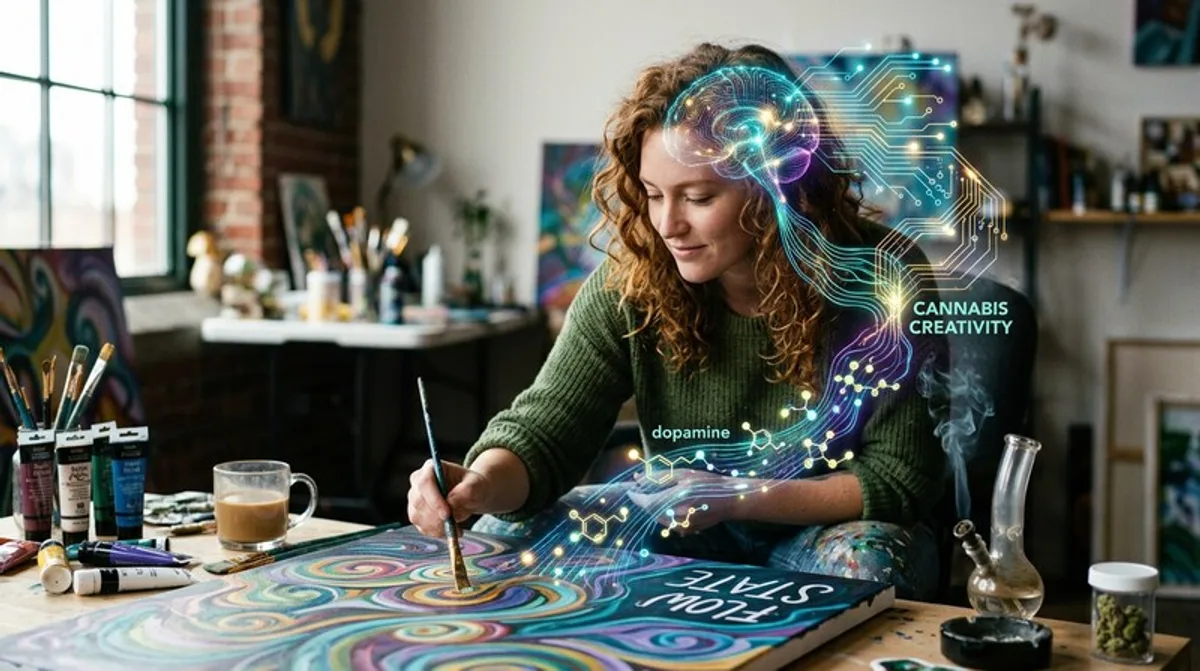
- THC and mesolimbic dopamine: THC increases dopamine release in the nucleus accumbens and prefrontal cortex through CB1 activation on GABAergic inhibitory interneurons (disinhibition). Increased dopamine availability → enhanced motivation, heightened salience of experiences, deeper immersion in activities
- Time perception and flow: THC alters time perception in a characteristic way — time subjectively appears to slow down. This effect promotes flow states: one becomes absorbed in the activity without paying attention to time
- Impulse reduction through amygdala suppression: Self-censorship is one of the biggest creativity inhibitors. CB1 in the amygdala suppresses fear of rejection and evaluation at low THC doses — lowers the creative inhibition threshold. Explains the “dare to try more” phenomenon
- Linalool and limonene as creativity terpenes: Strains with high limonene content (mood-enhancing, serotonin/dopamine modulation) and linalool (anxiolytic) show more favorable creative profiles than high myrcene-containing strains (sedating, couch lock). Terpene profile is more relevant for creative use than Indica/Sativa labeling. More on this: Cannabis Terpenes
When cannabis hampers creativity
- High doses — the creative coma: High THC doses (over 15–20 mg) lead to distractibility, disjointed thinking without a red thread, and reduced inhibition control — all hindrances for productive creativity. Many creative users know this: too much makes the mind empty, not full
- Chronic daily use: Regular daily THC use leads to chronically reduced dopamine baseline through CB1 downregulation — the exact opposite of the desired creativity effect. Amotivation and creative stagnation are documented long-term consequences: Cannabis Tolerance
- For already highly creative people: Schafer 2012 and Kowal 2015 show: people who are already very creative (high baseline creative people) benefit less — their DMN is already active, cannabis brings no improvement
- Wrong expectations: “Cannabis makes me more creative” is partially a placebo expectation. Malone et al. showed that the expectation of creativity-enhancing effects without cannabis can produce similar subjective feelings of creativity
Practically: Strains, doses and timing for creative use
- Low-dose principle: 2.5–5 mg THC are the proven doses for creative enhancement. Above that, the curve starts to go down. Microdosing (1–2.5 mg) as an alternative: no visible high, possibly increased creative baseline
- Strains with high limonene and pinene content: Durban Poison, Jack Herer, Super Lemon Haze — known for uplifting, alert-enhancing effects. Low-THC-high-CBD strains reduce the risk of overdoing it
- Timing: Cannabis for the exploration phase (brainstorming, first drafts, experimental work). Sobriety for critical revision, structuring, and final development
- Vaporizers for creatives: Vaporizers at low temperatures (160–170°C) preserve the terpene profile and allow more precise dosing than joints. Control over the intensity of the effect is especially important for creative use
Which terpenes for which effects — limonene and pinene for focus: Cannabis Terpenes. Cannabis for ADHD — creativity, hyperfocus and dopamine: Cannabis for ADHD. Tolerance development and creative stagnation through chronic use: Cannabis Tolerance.